

What Is ART, the New Enzyme System Discovered by Claude?
On September 23, 2026, Anthropic announced that Claude agents had identified a previously uncharacterized enzyme system in DNA sequence data. The researchers call it array-associated reverse transcriptases, or ART. However, the presence of repeats resembling CRISPR does not mean a finished gene-editing tool has been developed. ART's main biological function is still being investigated.[1]
What Was Discovered?
ART is found mainly in bacteriophages, viruses that infect bacteria. Its key components are a reverse transcriptase (RT), a neighboring companion gene, and an array of repeated DNA sequences separated by intervals. In early experiments, the researchers confirmed that the array is expressed as different short RNAs. The arrangement of repeats evokes CRISPR, but it is too early to conclude that it serves the same function.[1]
The reverse transcriptase itself had already been identified in earlier research. The novelty claimed in this announcement is the observation linking the adjacent noncoding repeat array and an accessory protein of unknown function into a single system.[1]
The Roles of AI and the Laboratory
According to Anthropic, after a scientist provided an initial search instruction, about 950 agents investigated sequences for 21 hours. They collected more than 200,000 reverse transcriptases, narrowed them down to 3,500 candidate systems, and analyzed 20 of those in detail. After one agent spotted an unusual repeat pattern, it measured the spacing, compared it with known systems, and wrote a report for human review.[1]
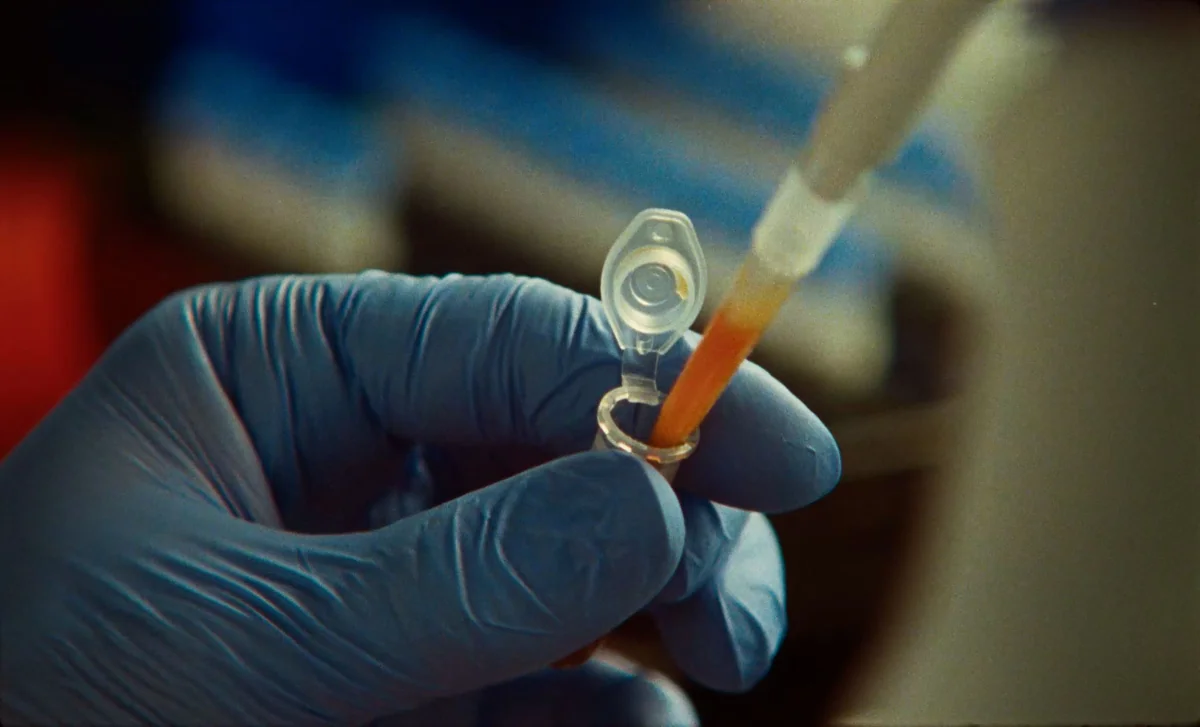
Here, "autonomous discovery" does not mean a robot conducted experiments on its own. Unlike the software stages of selecting and analyzing candidates, the actual experiments were performed by human scientists. The announcement states that the laboratory conducts only BSL-1 and BSL-2 research and does not handle pathogens that infect humans.[1]
| Confirmed Steps | Questions Still Open |
|---|---|
| An association between RT and repeat arrays was found in sequences | ART's original biological function |
| Early experiments showed that the arrays are expressed as short RNAs | Whether the system can be used as a tool to cut or copy DNA |
| A technical report was released as a preprint | Independent validation and follow-up experimental results |
GamZip's Perspective and Caveats
The significance of this case is that AI identified exceptions in a vast collection of sequences that warranted human review and narrowed them down for experiments. However, the announcing organization's early findings and preprint should not be interpreted as commercial technology or a medical achievement. ART's function and potential applications require further experiments and independent validation. GamZip has not tested the model directly or reproduced the experimental results.[1][2]
There are three things to watch: whether follow-up research establishes ART's function, whether other research teams reproduce the same system, and, if it can become a practical tool, how it differs from existing technologies.
Sources
[1] Anthropic, Claude discovers a novel enzyme system with CRISPR-like repeats (2026-09-23): https://www.anthropic.com/news/claude-discovers-novel-enzyme-system
[2] Technical report preprint by Anthropic researchers: https://www-cdn.anthropic.com/22573675ada52a8ca8a97a1a4b4326b2f208a071.pdf