

IBM and NASA release lunar AI: a research tool for ice and craters
IBM Research announced on September 10 that IBM and NASA had open-sourced the NASA-IBM Lunar Foundation Model, which brings lunar observations together.[5] This article is published in Korea on September 11, 2026. The key is not a new conversational chatbot, but a reusable research model that combines measurements from different instruments to study the lunar surface.[5]
What problem is the model trying to solve?
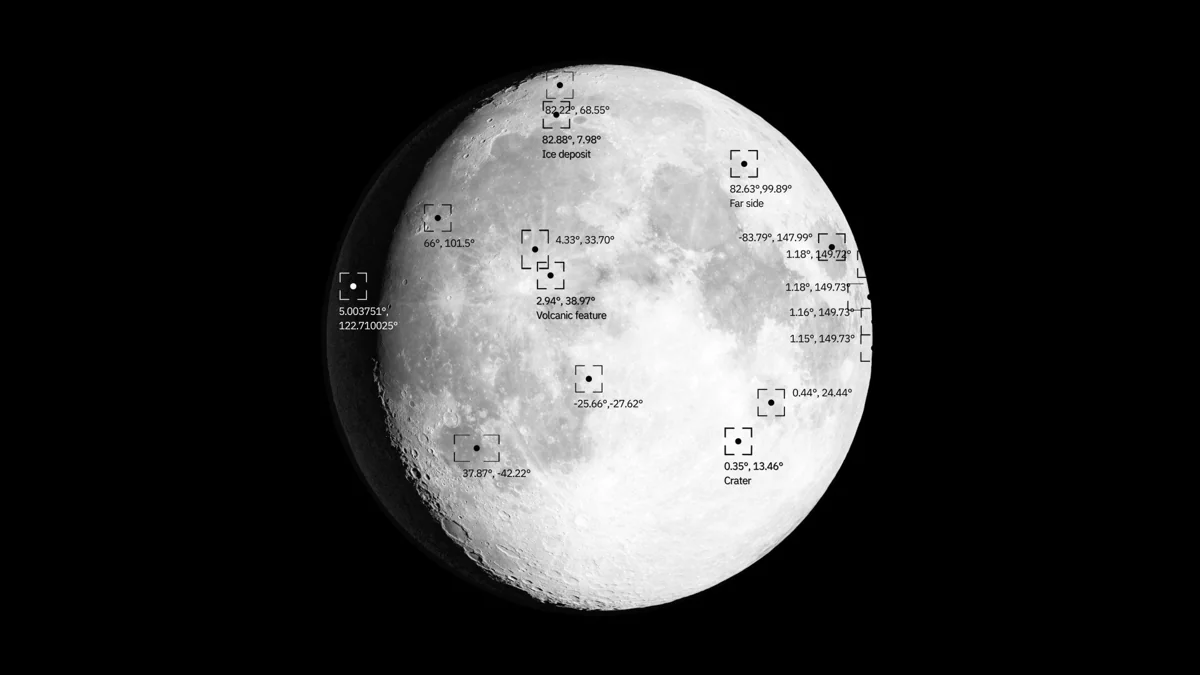
IBM says the model consolidates decades of observations collected by US and Japanese missions into a shared representation.[5] It integrates data with different modalities, viewing angles, and spatial resolutions, then adapts that representation to different research tasks.[5] The team used a version of TerraMind, the Earth-observation model developed by IBM and the European Space Agency.[5]
The three initial priorities are mapping small, uncatalogued craters, investigating volcanic history, and searching polar craters for ice.[5] In IBM's account, ice is a potential source of drinking water, oxygen, and fuel for future crews, not a resource whose availability has been established simply by releasing this AI model.[5]
Read performance numbers with their conditions
The researchers say they fine-tuned the model with lightweight LoRAs while keeping 90% of its base weights frozen.[5] This approach adapts the model to multiple tasks through limited changes rather than retraining every weight.[5]
IBM reports a 22% reduction in error when evaluating whether dark polar craters might contain ice, compared with a SwinV2 model trained for that task.[5] For crater detection, it reports accuracy comparable to a task-specific Swin model at one-meter resolution; at 100 meters per pixel, it reports outperforming the comparison model by nearly 19% with half the training data.[5] These different resolutions and tasks should not be rolled into a single accuracy-improvement figure. This article reports the publisher's evaluations, not tests that GamZip has run and reproduced independently.
GamZip's take: prioritizing searches, not declaring discoveries
The useful question here is less "What has definitely been discovered on the Moon?" and more "Where should researchers look more closely next?" IBM's example of ice prediction combines temperature and topographic information to highlight areas more likely to contain ice.[5] It is therefore important not to equate a prediction map with on-site confirmation.
GamZip sees the significance less in a race for general-purpose AI records than in a way to reuse fragmented scientific observations. Researchers considering the model should examine the technical report and evaluation data alongside the model itself. IBM's announcement links to a model download, technical report, and benchmark datasets.[5] Publication of the model and a judgment about its suitability for a particular study remain separate matters.
Sources
[5] https://research.ibm.com/blog/nasa-ibm-lunar-foundation-model